

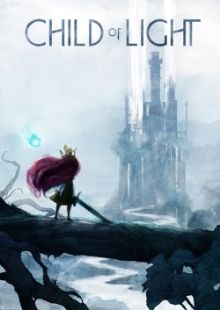
Scouring forum discussions and comments on other reviews, Child of Light appears to have captured the imagination of many a gamer. What’s most impressive about this, keeping in mind the general age and gender of your average gamer, is that the story is a fairy tale centred on the journey of a young girl attempting to reunite with her father. Certainly not your typical setting or protagonist when set against macho soldiers fighting never-ending wars on washed out battlegrounds. Perhaps it shouldn’t be too surprising, though; gamers have a strong penchant for nostalgia, which Child of Light taps in to with its fantastical setting and creatures, reminiscent of any Grimm story (or at least it’s Disney-ified reimagining).
The story is that of Aurora, a young Austrian of noble birth, much beloved by her father, a duke of the kingdom. Enter that most clichéd of fantasy villains, the stepmother. Conveniently, as her father’s attention is stolen by a new woman, a mysterious illness befalls Aurora. A deep sleep ensues, and our young heroine finds herself awake in the land of Lemuria, where the people/critters have their own issues, in the form of the Dark Queen Umbra. Aurora is thus cast as the saviour that had been foretold to save the land and return it from darkness. The story is largely played out silently: a voiceover occurs sporadically between chapters, but for the most part conversations are to be read. Presumably this is to allow for the rhyming nature of the dialogue: everyone in Lemuria is a (rubbish) poet, and here lies one of the few issues I had during the game. As a result of the constant rhyming, parts feel forced and as a result fail to flow naturally. It may seem minor, yet with such a focus on the fairy tale aspect, the story needed that bit more care in its execution.
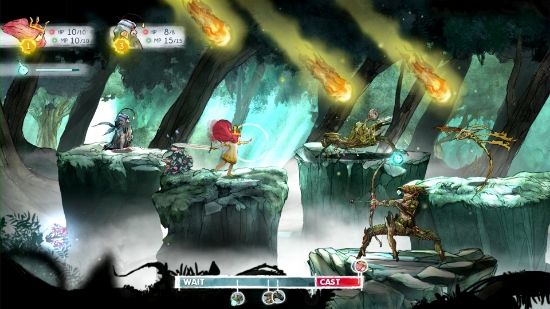
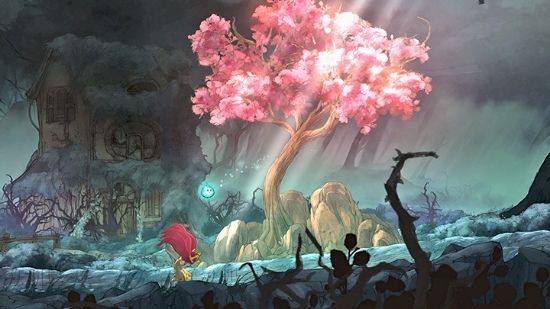
The same cannot be said for how the game looks. It is, in short, beautiful. Made with Ubisoft’s UbiArt engine (the similarities to the recent Rayman games should be immediately apparent to those that have played them, and even extend beyond the aesthetics and into the gameplay itself) each scene would not be amiss framed and hung in a gallery. Through haunted forests, underground caverns and quaint villages, the game is a visual joy to behold. We can expect many more games to come from this engine in the near future.
Considering the effort that has gone into creating the game, it would be a shame of the actual gameplay let it all down. While it may not be everyone, RPG fans should find it familiar and easy to adapt to. Combat is not randomly generated – creatures can be seen pacing a strict patrol. Getting too close or letting them sneak up behind you can result in an ambush, giving them a pre-emptive strike when battle commence. Conversely, it is relatively easy to catch them unawares and start with the upper-hand. This is made all the more likely once you gain the ability to fly, allowing you to drop onto enemies from above.
Combat is turn-based, with a slight twist. Everyone is put on the same action meter. Your two-character group and enemies all traverse it at different speeds. Towards the end there is a smaller meter, where you first select an action and then wait for it to be performed. Simple attacks have the shortest wait time, while magical attacks and powerful strikes take longer. This allows for an interesting dynamic, whereby if your character and an enemy are both charging an attack at the same time, if you manage to land yours first it will interrupt your opponent, forcing them back down the meter. In this way it is possibly to prevent an enemy from ever attacking. Also assisting you is a firefly, controlled using the right stick. In the world he can collect HP and MP granting orbs, and during fights he can be illuminated over enemies to slow them down, or over comrades to heal them. Slowing enemies gives you a chance to overtake them in their casting time and sneak in a shot first.
Levelling up occurs on a regular basis, so early on at least you never feel the need to grind. I completed more than half the game without once losing a character’s full HP, or even having to sue a potion. Some have used this as a complaint, saying the game is too easy and there is no sense of peril. Whilst this may be true early on, later stages force you to be more tactically aware to maintain this air of invincibility. There are also two difficulty options, so those wanting more of a challenge can jump into hard mode, where enemies won’t go down so easily and hit back harder. The game also grants you magical gems known as Occuli. These start as basic boosts, but as you collect more you can combine them to create ever more powerful variants. While you receive your first lot early on, it seemed peculiar that the game fails to mention them directly until almost halfway through the game, when you have probably familiarised yourself with their use long ago.

You are also aided by quite a substantial skill tree, acquiring a point to spend with each rise in level. Increases in defence, attack, magic etc. are all available as standard RPG fare, along with increased powers in moves. You can find stat specific boosts hidden around the world, which can bestowed on any character you wish. The game grants you a substantial party to assist Aurora on her adventure, from a tumbling clown seeking to find her brother, to a feisty mouse and a teenage (yet fully bearded) wizard aiming to prove his worth to his elders. While you can only have two in battle at once, switching between them is simple and certainly necessary as you’re forced to use their whole array of talents to overcome tougher foes. It is even possible to miss some characters, something which should be appreciated as an indication that you’re been given free rein to explore, without the game resorting to hand-holding or overwrought signs pointing you towards every secret.
For around €15, Child of Light is more than deserving of your consideration. Initially I had read of 10 hour completion times, which in itself is not even short compared to some other full-priced games. Yet factoring in all side missions, and should you wish to play though on hard mode, it is actually closer to 20 hours, more than enough to warrant the price. And for your time you spend with Aurora you will be treated to a fantastical adventure through one of the most original looking games to grace the One, and will probably remain so even after future titles have arrived. There is always a clamour for new and innovative IPs when developers prefer to keep it safe with sequels and familiar-feeling games. Ubisoft is sure to push this engine with more titles in the future, and hopefully this commitment to blending the world of games and art is rewarded and enjoyed by as many people as possible.
Play it if: you feel your gaming life has a distinct lack of whimsy and charm. There's only so many giant mechs you can obliterate before the soul cries out for something tender and warm-hearted.
Completion time: anywhere from 10-20 hours, based on difficulty level, side missions and generally flying around and enjoying that whimsy I mentioned earlier.
Similar to: old Final Fantasy, walks through country manor gardens, bit of Raymans Origins and Legends.
